
Listen to this article
Narrated by a synthetic Australian voice (8 min 33 s). Open the transcript to follow along.
Show the transcript
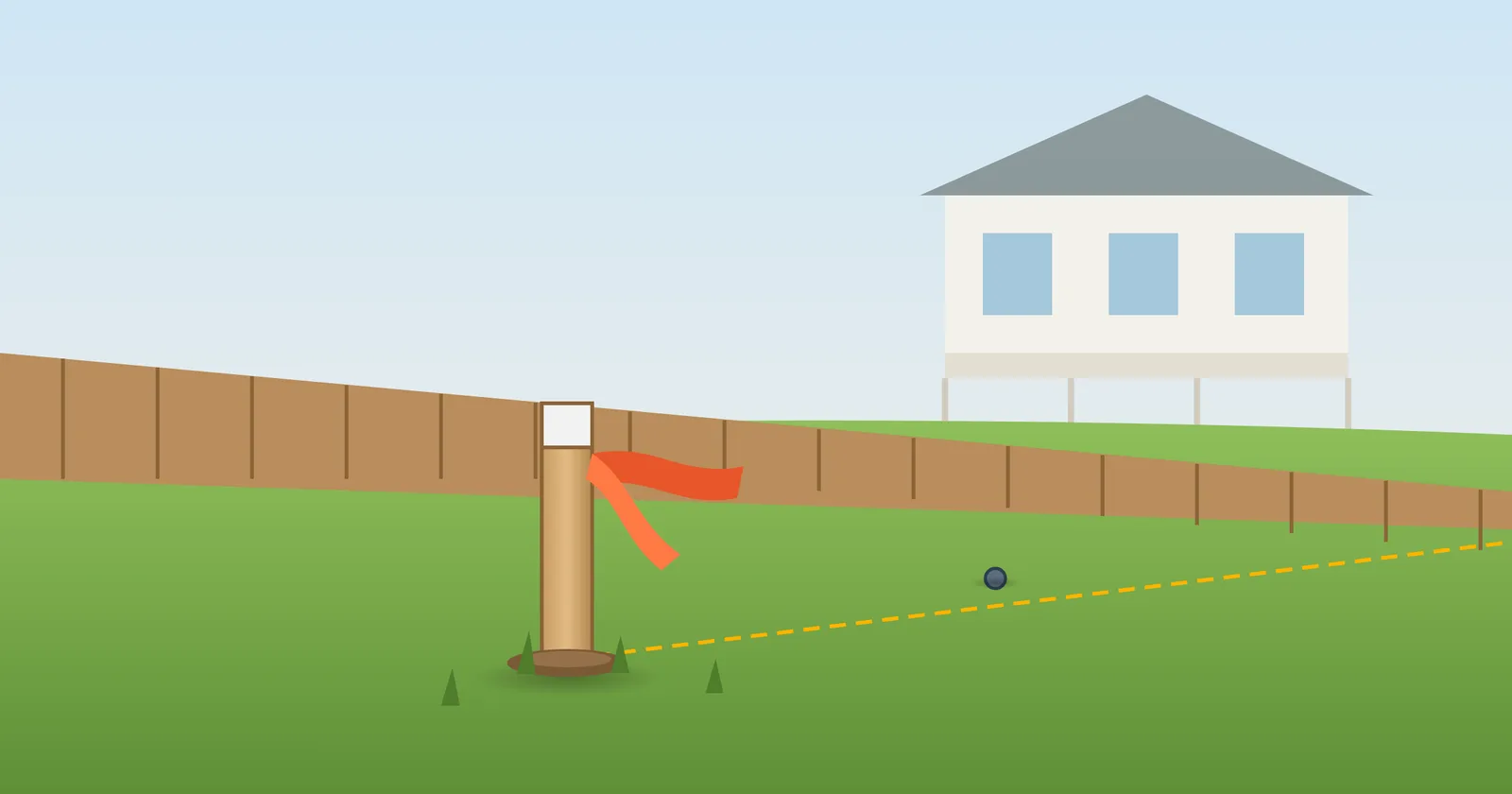
You've found a white timber peg near the fence, an iron pin in the grass or a nail in the kerb. Now someone needs to know where the boundary is. In Queensland that peg is probably a boundary or reference mark placed by a registered surveyor. It's a useful clue, but it isn't proof on its own, and you can't simply pull it out.
Below you'll find what each kind of mark means and what Queensland law says about moving one. You'll also find the four-question test we use with owners to decide whether a peg is good enough for the job in front of them.
General information only, not legal advice.
Found a peg near your fence? The short answer
A white peg at a corner of your block is most likely a cadastral boundary mark. Queensland Government guidance says property boundaries are defined by the survey marks at the corners, usually white pegs (Business Queensland, survey marks and property boundaries, checked 9 November 2026).
The short answer
- Leave the peg where it is. Disturbing a survey mark is an offence in Queensland, with narrow exceptions. The main one lets you disturb a boundary mark to build a fence, wall or other permanent structure along the boundary.
- A peg is evidence of where a surveyor once marked the corner. It can be knocked, moved or replaced over the years.
- Check it against your survey plan and the other corners before you build anything near the line.
- For a new fence, an extension close to the line or a disagreement with a neighbour, get the boundary marked again by a registered cadastral surveyor.
The marks you might find on a Brisbane block
Not every mark in the ground is a boundary corner. The first three rows below follow the Queensland Government's description of survey marks. The last row covers marks put in for building or service work, which are not boundary marks.
| What you see | What it usually is | What it tells you |
|---|---|---|
| White timber peg, often with a taller stake beside it | Boundary peg at the corner, with a finder stake | The corner as a surveyor marked it. The stake only helps you find the peg. |
| Iron pin buried nearby, or a nail in the kerb | Reference mark | Placed so a surveyor can put the corner back if the peg goes missing. It is not the corner itself. |
| Concrete block with a brass plaque, or a small kerb mark, with a number | Permanent survey mark | A long-term reference for surveys in the area, not your boundary. |
| Extra pegs or paint near a slab, footing or pipe | Often marks for building or service work | Placed for a job on site, not to define the boundary. Don't read them as the line. |
The Queensland Government page shows a peg and finder stake, a nail in a kerb and a buried iron pin. It describes permanent survey marks as substantial marks, such as a concrete block buried about 300 mm deep with a brass plaque, usually with a numeric identifier. The same page says only surveyors registered with the Surveyors Board of Queensland can carry out cadastral surveys, the surveys that place boundary marks.
The page also warns that you cannot find your boundary by measuring from the kerb, because survey plans do not show where the kerb sits.
Can you move or remove a survey peg in Queensland?
Usually not. Under section 42 of the Survey and Mapping Infrastructure Act 2003, you must not interfere with a survey mark you know about, or should know about. Only a few exceptions apply. The maximum penalty is 100 penalty units. At the penalty unit value of $172.70 that applies from 1 July 2026, that is $17,270 (Penalties and Sentences (Penalty Unit Value) Amendment Regulation 2026).
The exception that matters most to homeowners covers boundary marks. You may interfere with a cadastral boundary mark in order to put up a fence, wall or other permanent structure along that boundary. Permanent survey marks are stricter. They need written approval from the department before anyone disturbs them. If a mark is a trip hazard, the Business Queensland survey marks page explains how to report it. If you're in a disagreement about where a mark sits, our guide to resolving boundary disputes in Brisbane covers the next steps.
The four-question test before you rely on a peg
We use this test with owners before they spend money on a survey. If you can answer yes to all four, the peg is a reasonable guide for low-stakes jobs like garden beds. If any answer is no or unsure, treat the peg as a clue only.
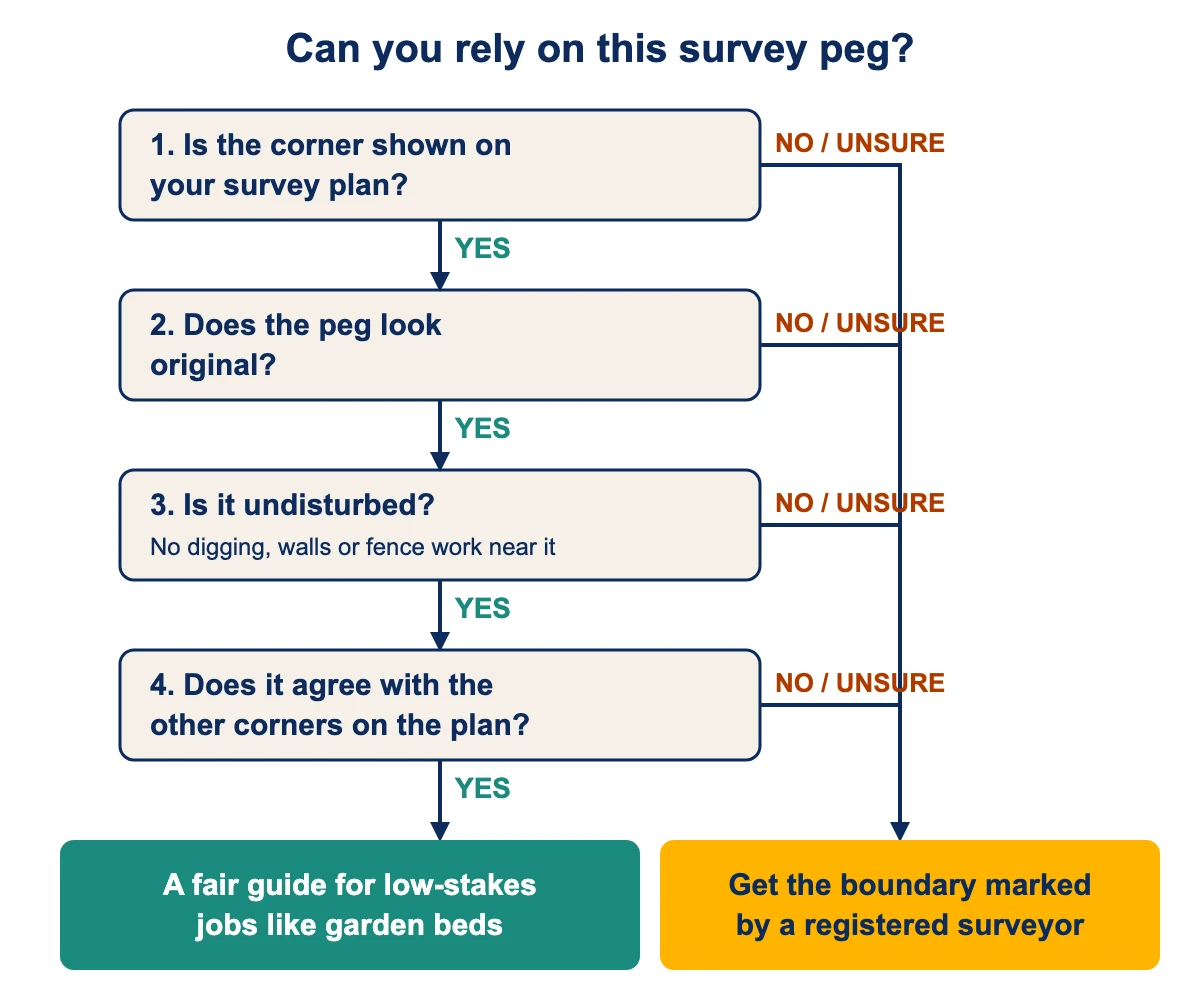
1. Is the corner shown on your survey plan?
Find your lot and plan number on your rates notice or in Queensland Globe. Then get a copy of the survey plan from Titles Queensland or an approved distributor (Business Queensland, survey plans). The plan shows the corners and the lengths between them. A peg in a spot the plan doesn't show as a corner is something else.
Older plans can be harder to read. Lengths may be in links, chains or feet, and where a row of lots is the same size, the dimensions may only be shown on the first lot.
2. Does the peg look original?
A peg that has been pulled and pushed back in, snapped and replaced with a stick, or reset by a fencer is no longer the surveyor's mark. Look for a clean, firm peg with its finder stake and reference marks nearby.
3. Is it undisturbed?
Driveways, retaining walls, landscaping and old fence removals all move pegs. If work has happened near the corner since the peg went in, assume it may have shifted.
4. Does it agree with the other corners?
Measure between pegs with a long tape and compare the distances with the plan, converting older units first. If two corners are a long way out from the plan, at least one of them is wrong. You can't tell which from the ground.
Answered no to any of these? Send us a photo of the peg and we'll tell you, free, whether you need a survey.
When a peg is good enough, and when to get the boundary marked again
A peg that passes all four questions is fine for planting, a garden edge or rough planning. It is not enough when the line itself carries a cost or a risk. Get the boundary marked again by a registered cadastral surveyor before:
- building or replacing a fence on the boundary
- an extension, carport, pool or shed close to the line
- settling a disagreement with a neighbour about where the line is
- buying or selling a property with structures close to the boundary
A common objection is "the fence has been there for 30 years". Under Queensland's Neighbourhood Disputes (Dividing Fences and Trees) Act 2011, a dividing fence is meant to sit on the common boundary. New or replacement fencing work under the Act goes on that boundary unless natural features make it impracticable. Where neighbours agree on another line, the Act says that does not change who owns the land.
If neighbours replacing a dividing fence cannot agree where the boundary is, either one can give written notice of a plan to have a cadastral surveyor define it. The other neighbour then has a month to get their own survey or confirm the line in writing. Each owner usually pays half the reasonable cost, unless the survey confirms the line the other neighbour gave in writing. In practice, an old fence shows where someone built a fence. It does not show where the title boundary is.
When we re-mark a boundary, we search the plans for the lot and its neighbours and find the existing marks. We check them against each other and against the plan, then place new pegs where the corners belong. We tell you what we found and which marks we replaced. If a fence or wall is in the way of a corner, we place an offset peg and explain how far it sits from the true corner.
Our boundary identification survey page sets out the service in full. Our article on how boundary surveys work for Brisbane owners covers the wider process.
What boundary marking costs in Brisbane and what you get
Our guide to land survey costs in Brisbane puts a full boundary identification for a residential lot at around $2,800 to $4,500 or more, including GST. Lots where the original marks are hard to find sit at the higher end. One Brisbane surveying firm publishes a basic fee for an identification survey on a standard 600 to 800 m² lot. It is $3,450 plus GST, about $3,795 including GST (checked 9 November 2026).
On a 2021 OzBargain forum thread, one Brisbane owner said quotes to replace a single missing marker were $2,000 to $3,000. A commenter in the same thread who said they had worked as a Brisbane surveyor noted that plan search fees come on top.
One peg is not much cheaper than four. The work is in the records search and the measurements needed to put any corner back in the right place, not in hammering the peg. For a quote on your block, send us your address, your lot and plan number if you have it, and a photo of the pegs you've found.
Not sure the peg is right?
We've been marking Brisbane boundaries for more than 10 years. Tell us what you've found and we'll tell you, free, whether you need a survey.
GET A FREE BOUNDARY QUOTEOr call (07) 3477 9914, Monday to Friday, 7am to 5pm.
Frequently Asked Questions
What does a survey marker look like? +
In Queensland, a boundary marker is most often a white timber peg at a corner, sometimes with a taller finder stake beside it. Reference marks nearby are usually a buried iron pin or a nail in the kerb. Permanent survey marks are different. They are a concrete block or small kerb mark with a number, used as a long-term reference rather than a boundary corner.
Can you remove a survey peg? +
Not without a reason the law allows. Section 42 of the Survey and Mapping Infrastructure Act 2003 makes it an offence to interfere with a survey mark, with a maximum penalty of 100 penalty units. The main exception lets you disturb a boundary mark to build a fence, wall or other permanent structure along the boundary. Permanent survey marks need written approval from the department.
Is the fence my boundary? +
Not necessarily. A dividing fence is meant to sit on the common boundary, but fences are sometimes built off the line. A fence placed off the boundary by agreement does not change who owns the land. A survey against the registered plan is the way to know.
Who can put a survey peg back? +
Only a surveyor registered with the Surveyors Board of Queensland can carry out the cadastral survey that places or reinstates boundary marks. If you disagree with where a surveyor put a mark, raise it with the surveyor first.