
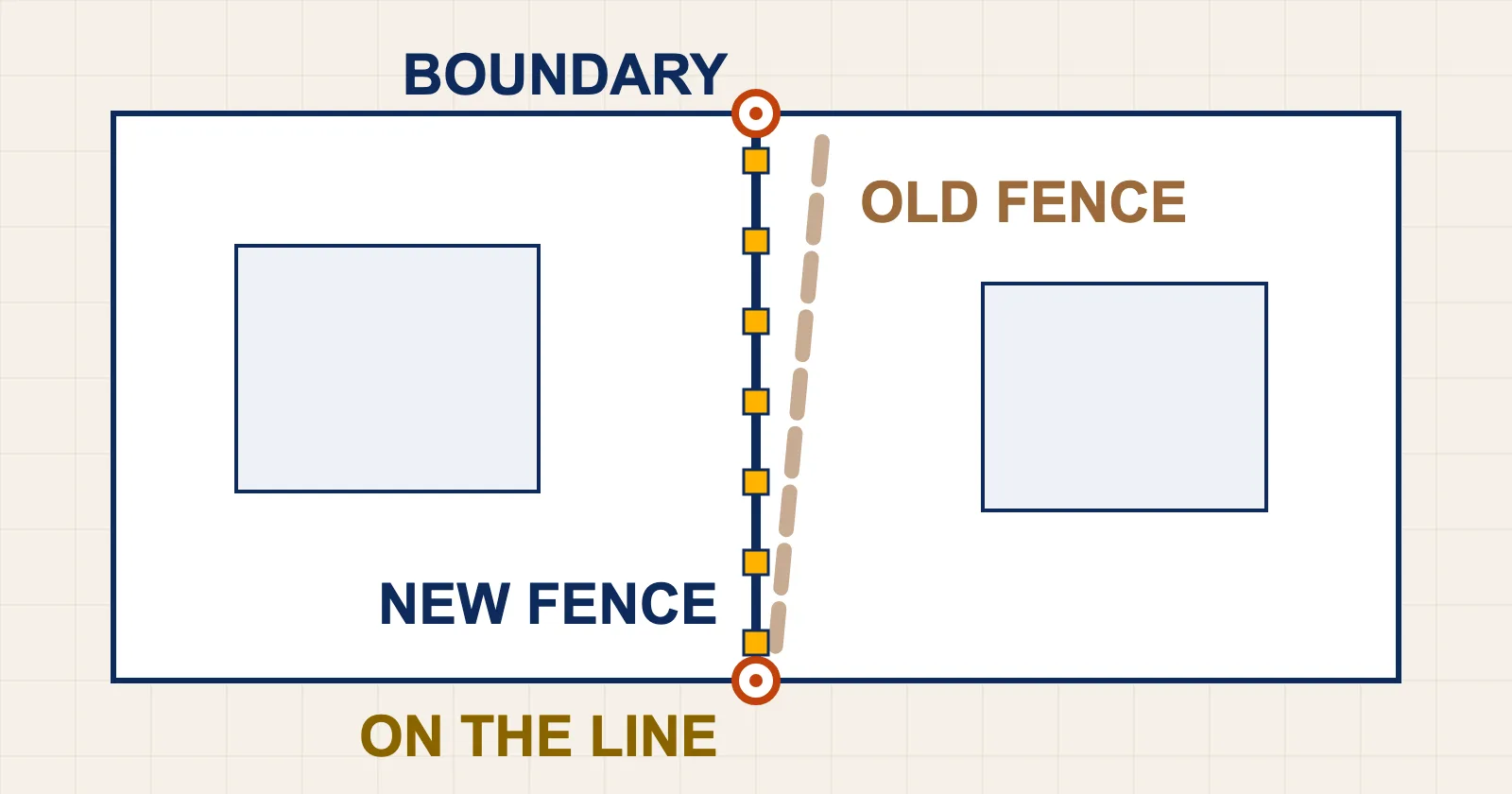
Replacing a dividing fence in Queensland goes best in a set order. Confirm where the boundary is, agree the fence with your neighbour and get a written quote. Then give a formal notice to contribute if you need one. Building comes last. The rules come from the Neighbourhood Disputes (Dividing Fences and Trees) Act 2011, often called the Dividing Fences Act QLD. Under it, neither owner may start work until you've agreed, unless the repair is urgent.
This guide walks through each step, what the Act requires, the timeframes in the notice, and where a boundary check fits.
General information only, not legal advice. Sources checked against the Act and qld.gov.au on 23 November 2026.
Replacing a dividing fence in Queensland: the order that works
The short answer
- Confirm the boundary. The new fence must go on the common boundary, and the old fence may not be on it.
- Talk to your neighbour. Agree the type, height and line of the fence, and check whether it needs approval.
- Get at least one written quote. Two lets your neighbour compare.
- Agree in writing, or give a notice to contribute for fencing work. If you haven't agreed within one month, either of you can apply to the tribunal.
- If you still can't agree, try mediation (free in most cases). Any tribunal application must still be made within two months of the notice.
- Build on the agreed line once you have agreement or an order.

What the Dividing Fences Act QLD says about building and paying
The Neighbourhood Disputes (Dividing Fences and Trees) Act 2011 sets the ground rules for fences between neighbours. Four of them shape the whole job:
- On the boundary. A dividing fence is a fence on the common boundary. When a fence is built or replaced, it must go on that boundary, unless natural features make that impracticable (sections 12 and 20).
- A "sufficient" fence. Between two residential lots, a sufficient fence is 0.5 to 1.8 metres high. It's made mainly of usual fencing material, such as timber, chain wire, metal panels, brick, concrete block or a hedge. It's also sufficient if you both agree it is (section 13).
- Equal shares. Neighbours contribute equally to fencing work for a sufficient fence. If one of you wants something better, such as a taller fence or dearer material, that owner pays the extra (section 21). A share can be paid in money, labour or materials (section 20).
- Agreement first. Apart from urgent work, the duty to contribute is enforceable only once you've agreed, or the Queensland Civil and Administrative Tribunal (QCAT) has ordered it (section 20).
Retaining walls aren't fences under the Act, and fences that form part of a pool barrier follow separate pool safety rules. If your fence is either of these, the steps below won't fully apply.
Step 1: Confirm where the boundary is
Old fences drift. They get rebuilt around trees, follow an old line, or were never quite on the boundary to begin with. The Act asks for the replacement on the common boundary, and the notice to contribute must state the line you propose to build on. So the line comes first.
It matters for ownership too. The Queensland Government's guide for fence owners explains that a fence on the boundary is owned equally. A fence built on one neighbour's land belongs to that neighbour, even if the other helped pay for it. If you're paying half, you want it on the line.
Start with what's free: your title plan, any survey pegs you can still find, and a conversation about where you both think the line runs. Our guide to survey pegs in Brisbane explains which marks you can rely on. If the old fence looks off, or a corner is unclear, a boundary identification survey marks the line on the ground before anything is quoted. Our fence survey guide covers how that marking works and what your fencer needs.
The Act counts surveying as part of fencing work, so the survey can be shared like the rest of the job. If you want your neighbour to pay half the survey, agree that first, or include it in your notice to contribute, before the surveyor comes out.
If you and your neighbour don't agree where the boundary is, section 40 has its own process. You give written notice that you'll have a cadastral surveyor define the line. Your neighbour then has one month to engage their own surveyor, or tell you in writing where they think the line is. If your survey puts the line in about the same position as their written advice, they pay nothing towards it. Otherwise you each pay half the reasonable cost.
On price, our land survey cost guide puts a boundary survey at about $2,800 to $4,500 or more, including GST, for most residential blocks. A survey can be scoped to the one boundary you're fencing. One example on our boundary survey page is a May 2026 Brisbane proposal for part of a front boundary: $2,970 including GST, the boundary part of a larger quote.
One Brisbane surveying firm publishes a basic fee of $3,450 plus GST (about $3,795 including GST) for a standard 600 to 800 m² lot. The corners needed, the records and how hard the old marks are to find all move the price. Figures checked 23 November 2026.
Not sure the old fence is on the line?
We've been marking Brisbane boundaries for more than 10 years. Tell us which fence you're replacing and we'll give you free advice on whether you need a survey, and a quote for that boundary.
GET A FREE BOUNDARY QUOTEOr call (07) 3477 9914, Monday to Friday, 7am to 5pm.
Step 2: Talk to your neighbour and agree the fence
The Queensland Government suggests talking face to face before any letters go out. Agreeing here means you may not need the formal notice at all. Cover four things:
- The line. Share what you found in Step 1.
- The type and height. A sufficient fence is the baseline you split equally. Anything above it, such as extra height for privacy or a dog, is paid by the owner who wants it. If the fence is part of a pool barrier, pool safety laws apply instead, and the pool owner who needs the work pays for it.
- Approval. Brisbane City Council says a fence needs building approval if it is more than 2 metres above natural ground. A fence that is part of a regulated pool barrier needs approval too. A fence on top of a retaining wall counts as one combined height. Unless you both agree otherwise, a fence between 1.8 and 2 metres is above the sufficient standard, so the owner who wants that height pays the extra. It still sits under Council's approval trigger.
- The old fence. Who removes it, and when. Demolition is fencing work too, so it's part of what you agree.
Step 3: Get written quotes
You need at least one written quote, and the Queensland Government suggests two as a courtesy. If your neighbour thinks the price is high, they can get their own. Ask each fencer to quote the same fence on the same line, including removal of the old fence, so the numbers compare fairly. If a boundary survey is part of the job, get that quoted too, so it can go in the same notice.
Step 4: Give the notice to contribute for fencing work
If you've agreed everything, put it in writing: the line, the fence, the cost and each share. If you haven't, or your neighbour isn't responding, the formal route is a notice to contribute for fencing work under section 31. It must be in the approved form, which the Queensland Government fence owner page links to. The notice states:
- a description of the land, and the line you propose to build the fence on
- the type of fencing work
- the estimated cost, including labour and materials
- the shares, if you are proposing something other than half each.
It must come with at least one written quote. From the day the notice is given, the clock works like this:
| When | What happens |
|---|---|
| Day 0 | You give the notice and the quote. Neither of you may start the work yet. |
| Within 1 month | You and your neighbour try to agree on the work and the shares. |
| After 1 month, within 2 months | If you haven't agreed, either of you may apply to QCAT for an order. |
| Once agreed or ordered | The fence can be built on the agreed or ordered line. |
Keep a copy of the notice and a note of the date and how you gave it. The two-month window runs from that date.
Step 5: If you can't agree, mediation or QCAT
If talks stall, the Queensland Government's dispute resolution centres offer mediation, which is free in most cases. Start early: the two months for a QCAT application still run from the date of the notice.
QCAT can decide dividing fence disputes valued up to and including $25,000. The Queensland Government explains how to apply to QCAT about a dividing fence. QCAT can order the line, the kind of fence, the shares and when the work is done. It can even decide that a fence goes off the boundary. An order like that doesn't change who owns the land on either side. Our guide to property boundary disputes in Brisbane covers the dispute side in more detail.
Step 6: Build on the agreed line
With agreement or an order in hand, the fencer can start. If the boundary was marked, keep the pegs safe while the old fence comes out, and check the new posts follow them. Don't pull down or put up a dividing fence without agreement or an order. Under sections 38 and 39, your neighbour can ask QCAT to stop the work, or to have the fence removed or fixed at your cost.
Urgent repairs after a storm or a fallen tree
Sometimes a fence can't wait a month, for example when a storm flattens it and a dog could get out. If giving a notice first is impracticable, section 28 lets you restore the fence to a reasonable standard straight away.
Then you can ask your neighbour to share the reasonable cost with a notice to contribute for urgent fencing work. That notice explains why the work was urgent and comes with the receipt. The same one-month and two-month timeframes apply. Keep it to a repair: a full replacement on a new line is better done the normal way. Pool barrier fences have their own urgent-work notice under the pool safety laws.
Dividing fence checklist
Print this and tick it off as you go.
| Step | Done when |
|---|---|
| 1. Boundary | You both accept where the line is, from the plan and marks, or from a survey. |
| 2. Fence agreed | Type, height, line, removal of the old fence and any approval are settled. |
| 3. Quotes | You hold at least one written quote for that fence on that line. |
| 4. In writing | A written agreement, or a notice to contribute given with the date recorded. |
| 5. Agreement or order | Agreed within a month, or a QCAT application made within two months (mediation does not pause this). |
| 6. Build | The new posts follow the marked line and both owners have their copies. |
Start your new fence on the right line
Tell us the address and which boundary you're fencing. We'll tell you whether the plan and existing marks are enough, or quote a survey for just that boundary.
GET A QUOTEOr call (07) 3477 9914, Monday to Friday, 7am to 5pm.
Frequently Asked Questions
Do neighbours have to pay half of the fence in QLD?
Usually, yes, for a sufficient dividing fence. Under section 21 of the Act, adjoining owners contribute equally. An owner who wants more than a sufficient fence, such as extra height or dearer materials, pays the extra. The duty is enforceable once you've agreed or QCAT has made an order.
Can my neighbour put up a fence without my permission in QLD?
Not a dividing fence, unless it's urgent repair work. Until you've agreed, or QCAT has ordered the work, neither owner may carry it out. If a neighbour builds or demolishes without that, you can apply to QCAT to stop the work or to have the fence removed or fixed.
Do you need council approval for a fence in Brisbane?
Brisbane City Council says you need building approval if the fence is more than 2 metres above natural ground. Approval is also needed if the fence is part of a regulated pool barrier. A fence on a retaining wall counts as one combined height. City Plan requirements can also apply, for example when building a new house on a site covered by a neighbourhood plan or overlay.
How long does my neighbour have to respond to a notice to contribute?
One month. If you haven't agreed within one month of the notice being given, either of you may apply to QCAT. The application must be made within two months of the notice.
Do I need a survey before replacing a dividing fence?
Not always. If the plan, the existing marks and your neighbour all agree on the line, you may not. If the old fence looks off the line, a corner is unclear, or you can't agree, a boundary survey marks the line before the notice and quotes. To share the survey cost, agree it with your neighbour first or include it in your notice.
What is the highest fence you can have between neighbours in QLD?
The Act doesn't set one maximum. A sufficient dividing fence between homes is 0.5 to 1.8 metres high, and that's the standard you share equally. If one owner wants it higher, they pay the extra. In Brisbane, a fence more than 2 metres above natural ground needs building approval.