

Understanding Subdivision in Brisbane
In Brisbane, subdivision is a critical process for property development that requires adherence to specific regulations and guidelines.
We'll explore:
- The pivotal steps involved
- The role played by Brisbane City Council
Key Steps in the Subdivision Process
The subdivision process in Brisbane can be intricate and involves several steps:
Initial Research
Understanding the Brisbane City Plan 2014 and relevant local laws is imperative. This step helps in determining the feasibility of the project.
Preparation of Development Application
You must meticulously prepare a development application, often with the help of a town planner or surveyor. This involves:
- Creating detailed plans
- Providing documents that comply with the Planning Act 2016
Lodging Application with Brisbane City Council
Then, you need to lodge the application with the Brisbane City Council for assessment.
Public Notification
For some types of subdivisions, public notification is required, where community feedback is considered.
Council Assessment
The Brisbane City Council will review the application against:
- The City Plan
- State government requirements
Decision
Lastly, the council will issue a decision, which can be:
- An approval
- Approval with conditions
- A refusal
It's crucial to be prepared for each step to ensure a smooth subdivision process.
Role of the Brisbane City Council
In the context of subdivision, the Brisbane City Council functions as the primary governing body that oversees development within its locality:
Assessment of Applications
The council meticulously assesses each development application for subdivision, ensuring it aligns with:
- Brisbane City Plan 2014
- Planning Act 2016
Approval Authority
It serves as the approval authority and issues development approvals for compliant applications, sometimes with conditions.
Guidance Provider
For property owners and developers, the council acts as a guide, offering clarity on the regulations and expectations through resources such as the Guide to subdividing land.
Understanding the council's role is fundamental in navigating the complexities of subdivision while ensuring full compliance with local policies.
Planning and Development Application
In our approach to outlining the subdivision process in Brisbane, we must consider:
- The intricacies of development applications
- The corresponding approval route
Navigating through Queensland's legislative framework is crucial to ensure a seamless application pathway.
Development Applications and Approval
When we talk about subdividing land in Brisbane, development applications are the gateway to transforming land parcels into approved lots. Essentially, subdividing land involves dividing a single land parcel into multiple lots, a process tightly governed by regulations.
Once we formulate our development application, leveraging the guidance provided on the Brisbane City Council website is recommended.
Following planning approval, you must submit a survey plan for sealing. This ensures compliance with:
- The stipulated conditions
- Payment of any infrastructure charges levied
Queensland's Legislative Framework
To navigate the complexities surrounding development approvals effectively, you must simplify your understanding of Queensland's Legislative Framework.
The Planning Act 2016 is a critical document to focus on.
This act lays the groundwork for all development-related decision-making processes in Queensland and serves as a backbone for development applications concerning subdividing land.
Subdivision Strategies and Considerations
When approaching a subdivision in Brisbane, it's essential to understand:
- The complexities of local regulations
- The impacts it may have on the community and existing infrastructure
Assessing Subdivision Viability
Subdividing land requires thorough due diligence to ascertain the potential of a property.
This involves examining:
- Zoning regulations
- Understanding the Brisbane City Plan 2014
- Determining whether the lot is suitable for code assessment or "impact assessable" under the development assessment process
Key actions:
- Check zoning and planning scheme constraints
- Consult with a town planning consultant
- Consider RiskSMART for eligible projects
Community Impact and Infrastructure
Understanding the impact a subdivision has on the local community and infrastructure is crucial.
It's about more than just increasing housing options; it's also about ensuring that each lot is properly serviced, and that any increase in population aligns with the capacity of local services.
Essential considerations:
- Assess infrastructure charges for the subdivision
- Engage with the community to gauge infrastructure needs
- Plan for communal spaces if considering a community title scheme
Technical Aspects of Subdivision
In addressing the technical aspects of subdivision in Brisbane, we explore:
- The intricacies of property mapping
- The navigation of legal constraints
Surveying and Property Mapping
When subdividing land, the initial step we undertake is a detailed survey. This process includes the preparation of a survey plan, which precisely maps:
- The proposed lots
- Any easements or encumbrances on the land
The survey plan is a vital document, as it outlines:
- The lot sizes in square metres
- Essential elements such as lot frontage
Managing Legal Constraints in Subdivision
Comprehending and managing legal constraints is paramount in our subdivision process.
Reconfiguring a lot involves not just the creation of new lots but also:
- The potential for creating new easements
- Altering the existing ones
Creating an easement is a legal process that grants the right to use a portion of land for a specific purpose, such as access or the provision of utilities, without the transfer of ownership.
Financial Factors in Subdivision
Dealing with Costs and Overheads
When subdividing land in Brisbane, we must consider a range of development costs that affect the overall financial viability of the project.
This includes infrastructure charges levied by the Brisbane City Council. These charges are contributions towards the cost of community infrastructure necessitated by the development.
Maximising Subdivision Investment Potential
To enhance our investment potential in a Brisbane subdivision, we must strategise effectively.
Firstly, we need to perform a thorough feasibility study to understand:
- The specifics of the council's planning scheme
- Any financial constraints
Frequently Asked Questions
What are the current subdivision regulations set by the Brisbane City Council? +
The Brisbane City Council sets out specific regulations for reconfiguring lots, which includes:
- Creating new parcels of land
- Merging
- Boundary rearrangement
- Community title schemes
What are the associated costs for subdividing land in Brisbane? +
The costs involved in subdividing land can vary. It often includes expenses such as:
- Council fees
- Surveying
- Legal costs
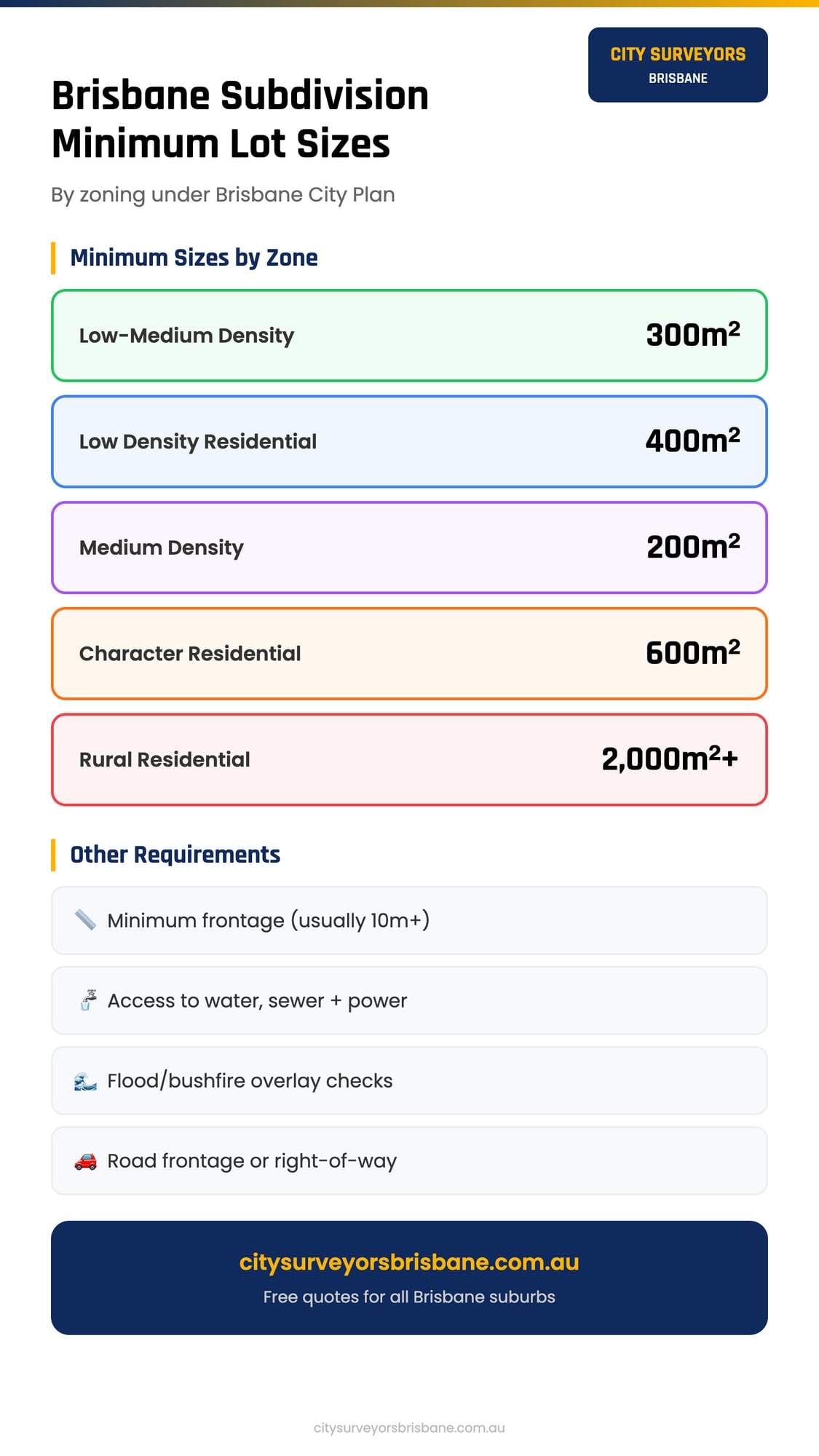
What is the minimum plot size required for land subdivision in Queensland? +
The minimum land size for subdivision can differ depending on local planning schemes, with specific zones and overlays affecting the minimum lot size.
What is the typical duration for completing a land subdivision process in Queensland? +
The duration for completing a land subdivision varies based on complexity, but it generally takes several months to obtain all necessary approvals and complete the required works.