
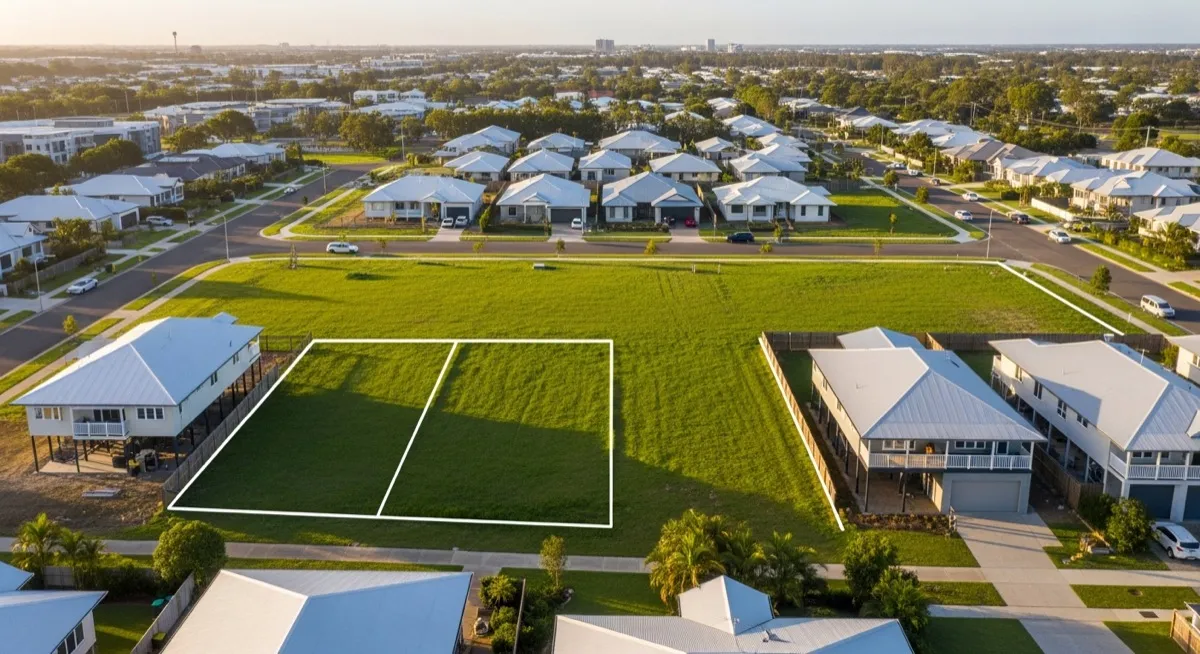
Subdividing land in Brisbane means legally splitting one property into two or more separate lots, each with its own title. The process is governed by the Planning Act 2016, Brisbane City Plan 2014, and the Survey and Mapping Infrastructure Act 2003. A standard 2-lot subdivision in Brisbane takes 4–8 months and costs $40,000–$60,000 including all professional fees, council charges, and infrastructure contributions.
This guide covers every step - from checking if your block qualifies to getting new titles registered.
What is the Minimum Block Size to Subdivide in Brisbane?
The minimum lot size depends on your property's zoning under Brisbane City Plan 2014. Here are the most common residential zones:
| Zone | Minimum Lot Size | Minimum Frontage |
|---|---|---|
| Low density residential (character) | 400m² | 10m |
| Low density residential | 400m² | 10m |
| Low-medium density residential | 300m² | Variable (often 8m) |
| Medium density residential | No minimum (subject to planning) | Variable |
| Emerging community | Varies by precinct | Varies |
Important caveats:
- These are base minimums. Neighbourhood plans and overlays can impose larger minimums. For example, parts of Ashgrove, Paddington, and The Gap have character overlays requiring 600m²+ lots.
- Your existing lot must be large enough for BOTH new lots to meet the minimum, PLUS any required access (e.g., a driveway easement for a rear lot typically needs 3.5m–4m width).
- Corner lots often have better subdivision potential because both new lots can have street frontage.
Quick Subdivision Feasibility Check
Before spending money on professionals, do this yourself:
- Find your lot size and zoning: Go to Brisbane City Council's City Plan mapping - enter your address, check the zone and any overlays
- Check minimum lot sizes: Look up your zone in the table above
- Do the maths: Can your block be split into lots that each meet the minimum size AND frontage?
- Check overlays: Flood, character, heritage, bushfire, waterway corridor - these can block or complicate subdivision
- Check services: Both lots need independent access to water, sewer, stormwater, electricity, and telecommunications
If it looks viable, engage a surveyor and town planner for a formal feasibility assessment.
How Much Does It Cost to Subdivide in QLD?
Here's a realistic cost breakdown for a standard 2-lot subdivision in Brisbane (2026):
| Cost Item | Typical Range |
|---|---|
| Surveyor fees (survey, plan preparation, lodgement) | $5,000–$8,000 |
| Town planner fees (DA preparation, council liaison) | $3,000–$8,000 |
| Brisbane City Council DA fees | $1,500–$5,000 |
| Infrastructure charges (per additional lot) | $28,000–$35,000 |
| Engineering reports (stormwater, services) | $2,000–$5,000 |
| Legal fees (easements, covenants) | $1,000–$3,000 |
| Titles Queensland registration | ~$200 per lot |
| Miscellaneous (searches, notifications, admin) | $500–$1,500 |
| Total estimate | $42,000–$67,000 |
Why Does Subdividing Cost So Much?
The single biggest cost is infrastructure charges - Brisbane City Council charges approximately $28,000–$35,000 per additional residential lot created (2025/26 adopted charges resolution). This covers the council's cost of providing water, sewer, stormwater, transport, and parks infrastructure for the new lot.
Despite these costs, subdivision is often highly profitable. A 700m² block in suburbs like Camp Hill, Holland Park, or Carina might be worth $750,000 as one lot, but $500,000–$600,000 per lot as two 350m² lots - creating $250,000–$450,000 in value.
Step-by-Step Subdivision Process in Brisbane
Step 1: Feasibility Assessment (Week 1–2)
Engage a subdivision surveyor and town planner to assess your block. They'll check zoning and minimum lot sizes, overlays and constraints, existing easements and encumbrances, access and services availability, and whether the subdivision is code assessable or impact assessable.
Step 2: Survey and Plan Preparation (Week 2–4)
Your cadastral surveyor conducts a boundary survey and detail survey of the existing property, then prepares a proposed subdivision plan showing new lot boundaries, easements, building positions, and compliance with minimum lot sizes.
Step 3: Development Application (Week 4–6)
Your town planner lodges the DA with Brisbane City Council. Council processes most code-assessable residential subdivisions within 20–30 business days. Impact-assessable applications take 40–60+ business days.
Step 4: Council Decision (Week 8–14)
Council either approves (with conditions), requests further information, or refuses.
Step 5: Satisfy Conditions and Complete Works (Week 14–24)
Pay all infrastructure charges, complete any required physical works, obtain compliance certificates, and register any required easements.
Step 6: Plan Sealing (Week 24–28)
Once all conditions are satisfied, council seals the subdivision plan.
Step 7: Title Registration (Week 28–32)
Your surveyor lodges the sealed plan with Titles Queensland. New titles are created within 2–4 weeks. You now have separate, sellable lots.
Brisbane Suburbs with High Subdivision Potential
Inner suburbs (high land value, character overlay challenges): Coorparoo, Camp Hill, Holland Park, Greenslopes, Annerley - many 600m²+ lots in low-medium density zones, but character overlays may apply.
Middle suburbs (good balance of value and feasibility): Mansfield, Carindale, Mount Gravatt, Upper Mount Gravatt, Sunnybank Hills, Wishart - larger lots, fewer overlays, strong demand.
Outer suburbs (larger lots, lower infrastructure costs): Springfield, North Lakes, Redbank Plains, Morayfield - newer estates with established services, but lower per-lot values.
Common Reasons Subdivisions Get Refused in Brisbane
- Lot sizes below minimum - even 1m² short will get refused
- Inadequate frontage - rear lots need legal access via easement or battle-axe driveway
- Stormwater non-compliance - can't demonstrate adequate drainage for the new lot
- Character overlay conflicts - subdividing in a character area may be refused if it changes neighbourhood character
- Infrastructure constraints - insufficient sewer or water capacity in the area
Frequently Asked Questions
Can I subdivide my block myself without a town planner? +
Technically yes for code-assessable applications - you can lodge the DA yourself. However, the planning assessment report requires detailed knowledge of Brisbane City Plan 2014, and mistakes cause costly delays. Most property owners save time and money by engaging a planner.
How long does subdivision take in Brisbane? +
A straightforward 2-lot code-assessable subdivision typically takes 4–8 months from initial survey to registered titles. Impact-assessable or complex subdivisions can take 12–18 months.
Can I subdivide if there's an existing house on the block? +
Yes - this is the most common type of residential subdivision in Brisbane. The existing house stays on one lot, and the new lot is either vacant or gets a new dwelling.
Do I need to build on the new lot before I can sell it? +
No. Once new titles are registered, you can sell the vacant lot immediately. Many Brisbane subdivisions are done specifically to sell the vacant lot.
What's the difference between subdivision and boundary realignment? +
Subdivision creates NEW lots (increasing the total number). Boundary realignment changes the boundary between EXISTING lots without creating new ones. Realignment is simpler and cheaper - no infrastructure charges - but both require a cadastral surveyor.
Ready to explore subdivision for your Brisbane property? City Surveyors Brisbane provides free feasibility assessments and fixed-price subdivision quotes. Contact us today.